AI Doesn’t Replace Experience — It Scales It

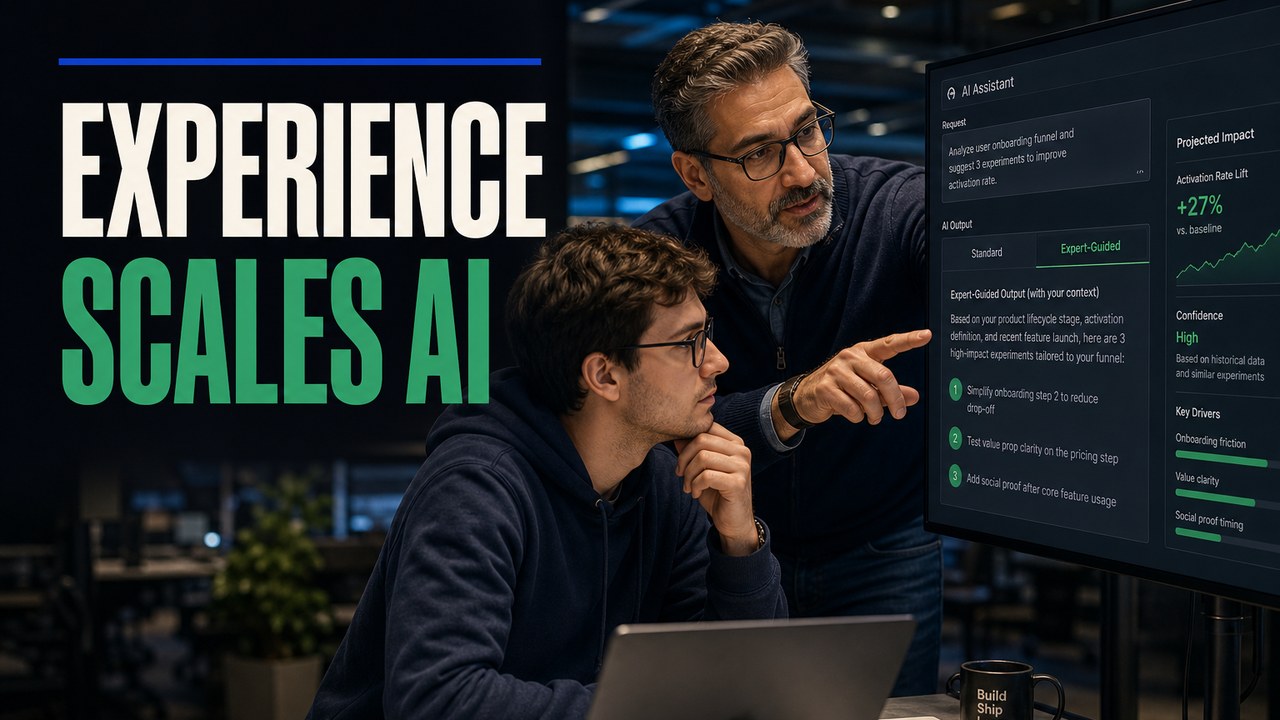
Every time a new wave of AI capability ships, I get the same question from other CTOs: "Does this mean my senior engineers matter less?"
The honest answer is the opposite of what most people expect. AI makes senior engineers more valuable — not less.
Here's why. A junior engineer with an AI assistant can now ship code that used to require three years of experience. But a principal architect with an AI assistant can evaluate two hundred architecture proposals in a morning, surface hidden coupling across sixteen services, and generate migration plans that would have taken a team a quarter to produce.
Experience is the multiplier that makes AI useful. Without the judgment to ask the right questions and spot the wrong answers, AI is just a faster way to build the wrong thing.
The Experience Advantage Compounds
Experience doesn't just mean "knows more facts." Pattern recognition — a senior engineer has seen the same failure mode in three different contexts. When AI suggests an approach, they recognize the hidden risk the model didn't surface.
Context weighting — not all outputs are equally important. Experience tells you which code paths matter, which metrics to watch, and which shortcuts are acceptable.
Judgment calibration — AI generates options. Experience selects among them. A junior engineer might pick option A because it's fastest. A senior picks option C because they know the deployment infrastructure can't support A at scale.
What Changes for Senior Engineers
The work itself changes. Senior engineers spend less time writing code and more time reviewing AI-generated designs for architectural soundness, tuning prompts to encode organizational knowledge, building feedback loops that keep AI aligned with business goals, and mentoring junior engineers on how to evaluate AI outputs.
The senior engineer who embraces this shift doesn't become less relevant. They become the person who makes the entire team faster. That's always been the job — AI just makes the leverage explicit.
The Real Risk
The real risk isn't that AI replaces senior engineers. It's that your most experienced people resist this shift and get bypassed by teams that do use AI effectively. A mid-level engineer with good AI skills will outperform a senior engineer who refuses to work with AI — but only on narrow, well-defined tasks. The moment the problem gets ambiguous, the senior's judgment reasserts its value.
The organizations that win will be the ones where senior engineers lead the AI adoption. Not because they're forced to, but because they recognize that AI is the most powerful scaling tool they've ever been given.
What This Means for CTOs
Your hiring bar shouldn't drop. It should shift. You still need people who understand systems, trade-offs, and failure modes. You just need fewer of them doing grunt work and more of them doing the work that only experience enables — deciding what matters, spotting what's wrong, and designing systems that stay right.
What This Means for Career Growth
I'm seeing a clear pattern in hiring. Companies are desperate for experienced engineers who can work effectively with AI. They're not looking for people who can write the best prompts. They're looking for people who can evaluate AI outputs critically, spot when the model is making a bad assumption, and guide the system back on track.
That skill — evaluation — is fundamentally different from generation. Anyone can generate code with AI. Not everyone can look at AI-generated code and know whether it's safe, maintainable, and aligned with the system architecture. That requires experience.
Mid-level engineers who build this skill become invaluable. Senior engineers who already have it become irreplaceable.
The Risk of Complacency
There's a second danger, and it's the one I worry about more: experienced engineers becoming complacent. They assume their experience is a moat that AI can't cross. But AI is getting better at pattern recognition every cycle.
The moat isn't experience alone. It's experience combined with the willingness to learn new ways of working. The engineers who combine deep domain knowledge with AI proficiency are the ones who will write their own ticket.
That's true for leaders too. The CTO who understands both the technology and the organizational implications of AI adoption will be in demand for a long time. The one who relies solely on twenty years of experience without adapting will find that experience increasingly hard to leverage.
Think this argument fits your event? Tell me about the room — the calendar is selective.
Start a conversation