The AI Operating Model: Who Decides, Who Owns, Who Pays

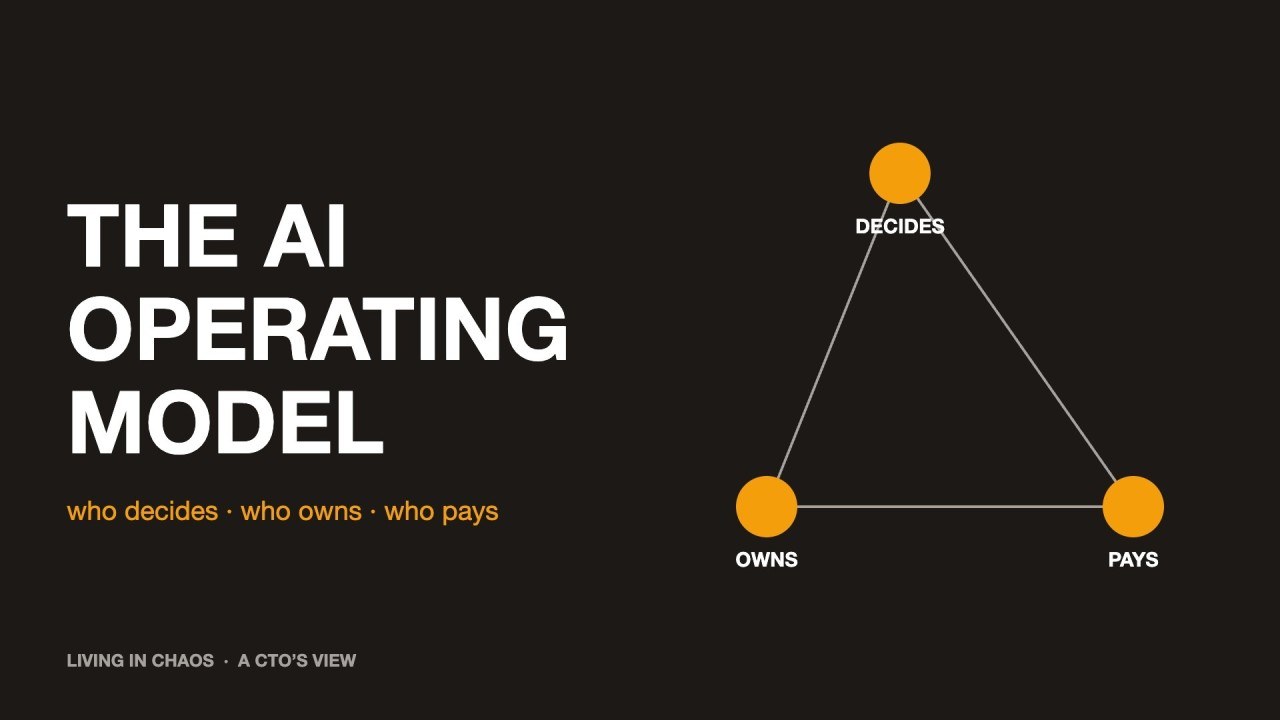
Most AI strategy decks answer the wrong question. They answer "what should we build." The question that determines whether any of it survives is "who decides, who owns, and who pays." Get the operating model wrong and the best use cases in the world die in the handoff between the team that built them and the team that has to live with them.
I've now watched this play out across enough business units to have a point of view. Here's the operating model we've landed on, and why.
Three questions, three different answers
The mistake is assuming one group should own all three. The CTO organization "owns AI," so it decides what gets built, operates what ships, and eats the cost. That's a recipe for a central team that's a bottleneck, a budget line nobody defends, and a business that treats AI as something done to it rather than by it.
Split them.
Who decides: the business, inside guardrails. The person who runs customer care decides whether an agent handles tier-one tickets. The person who runs supply planning decides whether a forecasting model goes into the weekly S&OP. They know the process, the risk, and the payoff. Technology sets the guardrails — permission tiers, data classification, approved models, the production readiness bar — and inside those guardrails the business chooses.
Who owns: a named operator in the business, with platform support. Not the data science team. Not the vendor. A person in the business unit whose job includes the weekly review, the override rate, and the escalation when it goes sideways. The platform team owns the harness: gateway, logging, cost controls, evals. The business owns what runs in it.
Who pays: the beneficiary, visibly. Every AI system gets a cost line in the P&L of the unit that benefits — tokens, compute, and operator time. Central technology carries the platform. The business carries the usage. The moment usage is free, you get a thousand pilots and no production. The moment it's charged, you get a hundred that matter.
Why central ownership fails
I ran it the other way for a while. A central AI team, taking requests, building and operating everything. It worked for the first five systems. By the fifteenth, the team was a queue, every business leader had an opinion about prioritization, and nothing had an owner at 2 AM who understood the process it was automating.
Centralized AI is a phase, not a destination. It's the right structure while you're learning what the harness needs to be. It's the wrong structure the moment the business is ready to run its own systems — and the business is usually ready before technology admits it.
Why fully distributed ownership also fails
The opposite failure is just as common. Every department gets a budget and a vendor login, and twelve months later you have forty disconnected tools, customer data in places legal has never heard of, and no way to answer the board's question about AI risk. Distributed decision-making only works on top of a central platform with real guardrails. Freedom inside a fence.
The structure, concretely
At the center: a platform team that owns the harness and the catalog. Gateway, identity, model access, permission tiers, logging, cost attribution, the eval framework, and the production readiness checklist. They don't build use cases. They make use cases cheap and safe to build.
In each major business unit: a small AI capability — often two or three people, sometimes one — that builds and operates the unit's systems on the platform. They report to the business leader. They have a dotted line to the platform team for standards.
Across both: a monthly review where every production system shows up with its owner, its cost, its override rate, and its last eval. It's the one meeting I protect.
The decisions that still sit with the CTO
Three things stay central, and I'd hold the line on them: which models and vendors are approved for which data classifications; the permission model for agents — what can read, write, and act irreversibly; and the readiness bar for production. Those aren't business decisions. They're the fence.
Everything else, I'd rather the business decide. They'll decide faster, they'll decide better, and when it's their cost line and their operator, they'll run it like it matters — because it does.
The test
Pick any AI system in production. Ask three people who decided it should exist, who owns it today, and whose budget it hits. If you get three clear, different answers, you have an operating model. If you get three versions of "technology," you have a pilot program that's going to get cut in the next budget cycle, no matter how well it works.
Think this argument fits your event? Tell me about the room — the calendar is selective.
Start a conversation