Architecture Reviews Should Be Continuous

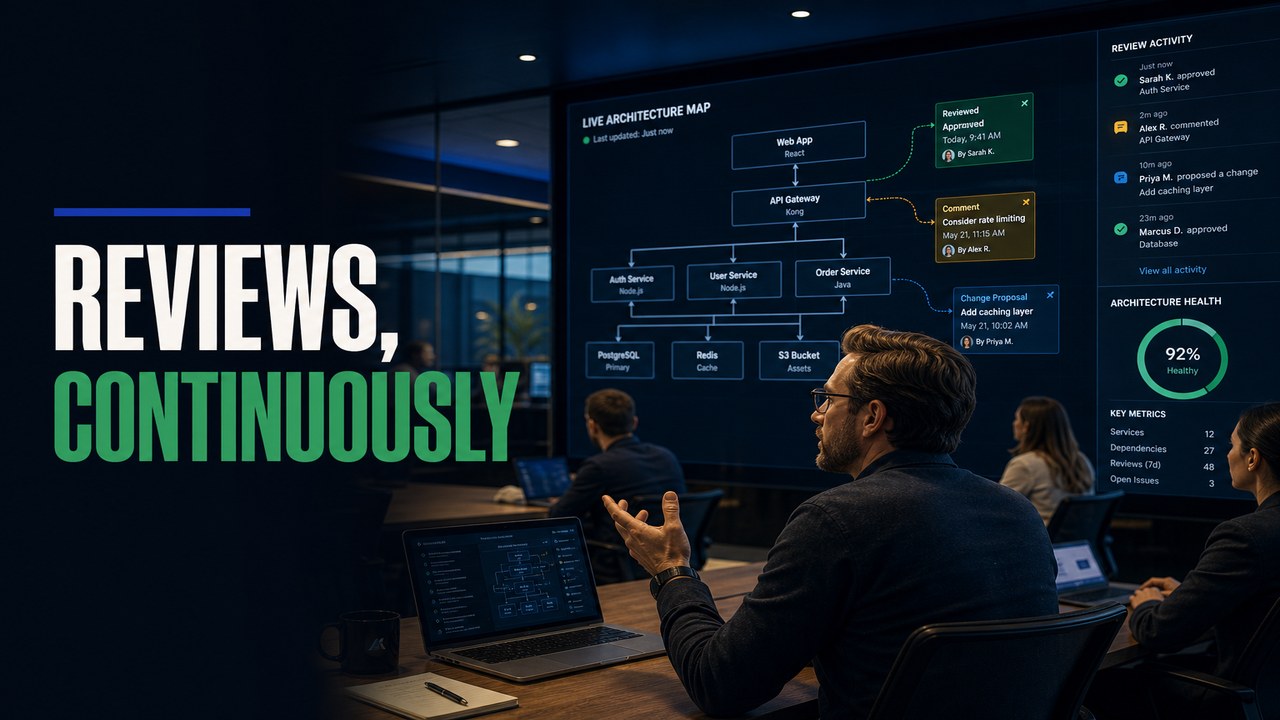
The traditional architecture review is thorough, expensive, and happens at most a few times per quarter. The problem is that architecture decisions are being made every day — in pull requests, config changes, and dependency updates.
Why Gated Reviews Don't Scale
Gated reviews were designed for a world where change was expensive. You reviewed upfront because changing direction later was costly. That assumption is breaking down. AI makes it possible to validate architecture continuously without requiring a human review board for every change.
What Continuous Validation Looks Like
A continuous system checks every change against your architecture standards. It flags violations in the PR, at the time the decision is being made — not weeks later. It tracks drift over time and surfaces recurring violations that suggest a standard needs updating.
The human architect focuses on setting the standards, reviewing exceptions, and making judgment calls. The AI handles the continuous monitoring. The humans stop being gatekeepers and start being system designers.
Where to Start
Pick one architecture standard your teams violate most often. Encode it as a review rule. Apply it to every relevant change. See what happens when violations are caught at commit time instead of review time. The result will be cleaner architecture, faster reviews, and architects who spend their time on architecture instead of gatekeeping.
The Problem with Periodic Reviews
Periodic architecture reviews have a fundamental flaw. They review the decisions that people remember to bring to them. The dangerous decisions are the ones that don't get reviewed — the config change that seems harmless, the dependency update that introduces a new pattern, the refactor that crosses an ownership boundary.
Continuous review catches these because it doesn't rely on human judgment about what's important enough to escalate. It checks everything against the same standards. Most changes are fine. The ones that aren't get flagged. The architect reviews the exceptions, not the entire volume.
What This Does to Team Culture
Teams that switch to continuous architecture review report an unexpected benefit. Engineers start thinking more carefully about architecture because they know every change will be checked. It's not about catching violations. It's about creating awareness. When engineers know that architecture standards are enforced at commit time, they internalize those standards faster.
The result is fewer violations over time, not because the system catches more, but because engineers learn what good architecture looks like and build it naturally. That's a better outcome than any review process can achieve.
The Real ROI of Continuous Review
The teams I've seen adopt continuous architecture review consistently report the same benefits. Architecture violations caught earlier. Review cycles shortened. Architects spending more time on architecture and less on gatekeeping.
But the biggest benefit is harder to measure. Teams make better architecture decisions because they have continuous feedback. They learn faster. They develop architectural judgment. Over time, the violation rate drops not because the system catches more, but because engineers have internalized the standards.
That's the real ROI. Not faster reviews — better engineers.
Think this argument fits your event? Tell me about the room — the calendar is selective.
Start a conversation