The Best Technical Leaders Will Think Like Systems Engineers Again

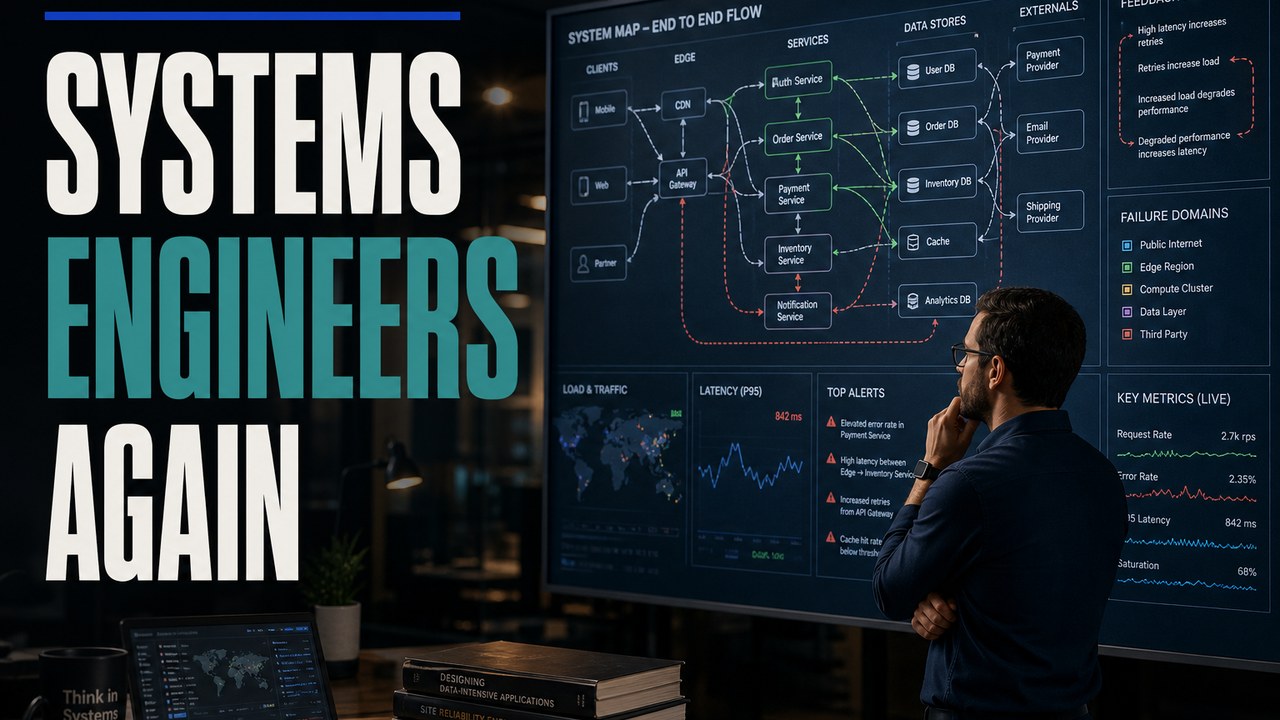
Modern software engineering has fragmented. Microservices, serverless, containers, managed services, event streams, data lakes. The result is a system so complex that no single person can hold it in their head.
AI is about to change that. Not by simplifying systems — but by restoring the ability to think about them as systems in the first place.
The Lost Art of Systems Thinking
Twenty years ago, a senior engineer could understand an entire system end to end. The database schema, network topology, deployment process, failure modes. Systems thinking was the default because the system was small enough to hold.
That's impossible today. So we've defaulted to component thinking. Engineers know their service but not its dependencies. Architects know the topology but not the runtime behavior. Leaders know the business outcomes but not the technical trade-offs.
How AI Restores Systems Thinking
AI can ingest system topology, runtime telemetry, code structure, and incident history. It can answer questions that no single human could alone. What's the blast radius of a failure in service X? Which dependencies are shared across multiple critical paths? Where is the system most likely to fail?
The Paradox
The more complex our systems become, the more valuable systems thinking becomes. And the harder it is to do without AI. The leaders who thrive will be the ones who think like systems engineers again — not because they can hold every detail in their head, but because they know how to ask the questions that unite the details.
Where to Start
Pick one system your team owns. Map every dependency — not just the direct ones, but the transitive ones. Trace every data flow from ingestion to output. Identify every single point of failure. You'll almost certainly find something no one knew was there.
How I Approach System Mapping Now
I start every new engagement by asking the AI to map the full system. Not the codebase — the actual running system with all its dependencies, data flows, and failure modes. The result is always revealing. There are always services that nobody remembers owning, dependencies on unmaintained libraries, and data flows that violate the team's stated architecture.
This exercise alone is worth more than a month of code review. Because code review tells you whether individual components are well-built. System mapping tells you whether the components fit together at all.
The leaders who do this regularly develop an intuition for system health that code review alone never provides.
Why Engineers Push Back
Engineers often resist system-level thinking because it feels abstract compared to code. Code is tangible. You can see it, test it, refactor it. Systems thinking feels like diagrams and theory.
But the best engineers I've worked with eventually realize that system-level understanding makes them better at every level. You write better code when you understand the system it runs in. You make better architecture decisions when you understand the full dependency chain. You design better interfaces when you understand how data actually flows.
Systems thinking doesn't replace code skills. It amplifies them.
Where Most Teams Get It Wrong
Most teams start with the technology — they pick an event bus, a data pipeline, a deployment model — and then try to fit the system into those choices. Systems thinkers start with the problem. What are we trying to accomplish? What constraints do we have? What failure modes must we survive? Only then do they choose the technology.
This may sound obvious. In practice, it's surprisingly rare. Most architecture decisions are driven by familiarity and comfort, not by systematic analysis of the problem space.
AI makes systematic analysis accessible to every team. It can model trade-offs, surface constraints, and identify options that the team might not have considered. The human's job is to ask the right questions about the problem. The AI's job is to provide the analysis that leads to the best solution.
Think this argument fits your event? Tell me about the room — the calendar is selective.
Start a conversation