The Living Knowledge Layer: Why I Stopped Believing in a Single Source of Truth

CIO News just published a profile on how we run AI agents at Ashley Furniture. This is my own take on it — what the write-up got right, and the part a third-party story can't quite hold.
CIO News published a piece this week about how I run AI at Ashley Furniture — “Ashley Furniture's CTO On Why A Living Knowledge Layer Keeps Agents And Developers On The Same Truth As Fleets Scale”. I don't usually write about coverage of myself, but the framing in that headline is the thing I've been trying to get across for two years, and I'd rather say it in my own words than let a paraphrase carry it.
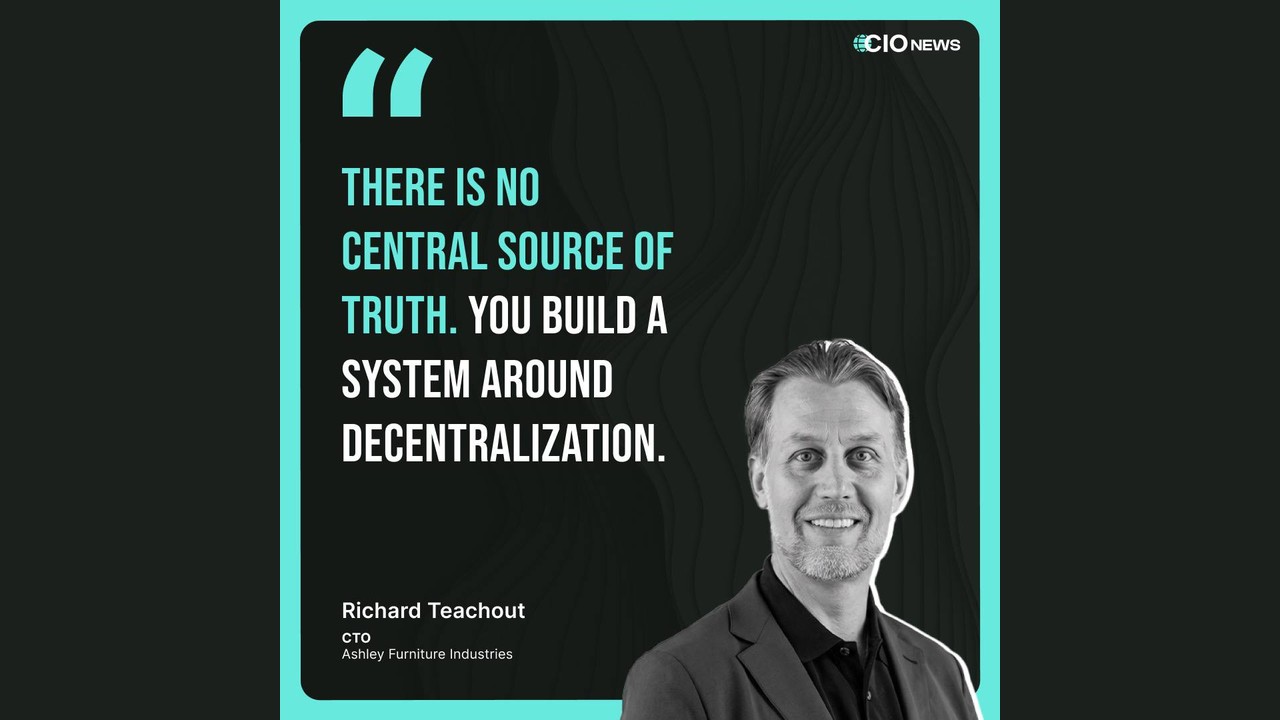
Here's the short version: there is no central source of truth. You build a system around decentralization.
The dream we all grew up on
Every enterprise I've worked in has chased the same artifact — the knowledge base. The wiki. The documentation portal. One canonical place where The Way We Do Things lives, and everyone reads from it.
It was always more aspiration than fact. The knowledge base goes stale the week after the migration. The documented process drifts from the real one. Runbooks describe a system that got redesigned in March. And for thirty years, that was survivable, because the only readers were humans — and humans are good at carrying the delta in their heads. You ask the person who was there. The tribal knowledge patches the docs.
AI removes that slack. When you have a fleet of agents in production and the developers sitting beside them, all acting on the same written knowledge, a repository that's out of date isn't a nuisance anymore. It's a liability that scales.
A layer, not a library
What we build instead is continuous, not curated. Machine-readable standards, logging, and workflows capture institutional knowledge as it gets created — and, more importantly, call out the moment the documented process and the real process pull apart.
It's the same picture in both places: a developer and their agent read from the same layer, at the same moment, in the same form. Managed through an MCP, backed by logging. When reality and documentation diverge, the system says so, instead of waiting for someone to notice in a postmortem three months later.
That's the whole idea of a living knowledge layer. Not a document you maintain. A signal that stays current.
Four things I'd underline
Judgment doesn't scale — it compounds. Our interns don't touch AI coding tools. They write HTML, C#, and Python by hand. They learn subnetting the slow way. Not because I'm nostalgic about keystrokes, but because supervision depends on comprehension. Feel the pain, understand what the machine does — otherwise you can't tell when an agent is confidently wrong. Knowing how to check the oil is the thing that lets you hire someone else to change it.
Build the differentiator, buy the rest. Which foundation model I use is a commodity and I genuinely don't care. Neither is the cloud. An agent is the opposite: it holds my processes, my data, my institutional judgment. That's the layer worth owning, and it's the only place the engineering effort should be pointed.
Governance goes at the front, not the back. Anyone can generate an app from a prompt. A production-grade system is a different act entirely. Governance, logging, centralization, observability — build them alongside the system, not after it. Most teams defer that until it's too expensive to add, and that deferral has always been a bet that the reckoning arrives later than the payoff.
That bet is now a bad one. I've watched this movie: unpatched SQL Server boxes behind public websites, and the outages that followed. Same mechanism — a foundation nobody hardened, giving way under load. The difference now is the clock. Debt that used to take five years to compound into a failure takes about sixty days when a fleet of interdependent agents is standing on it. One failure cascades into ninety-nine.
People-first is not a slogan
The line I'd want people to remember from the CIO News piece is this one: AI-first is also about people-first, or you lose your institutional knowledge and you're in trouble.
The engineers who understand how the business actually runs carry context no logging layer fully replaces. I tell every IT person in the organization the same honest number: I expect AI to take on roughly 70% of what they do today. I mean that as freed capacity — higher-value output, and stewardship of the agents now carrying the routine load. The agents need stewards. Investing in those stewards is what builds the governance that makes any of this last.
A company that stops investing in them watches that context walk out the door, and no amount of tooling gets it back.
Read the full CIO News profile: Ashley Furniture's CTO On Why A Living Knowledge Layer Keeps Agents And Developers On The Same Truth As Fleets Scale.
Think this argument fits your event? Tell me about the room — the calendar is selective.
Start a conversation