Designing the Human Review Queue That Doesn't Become a Bottleneck

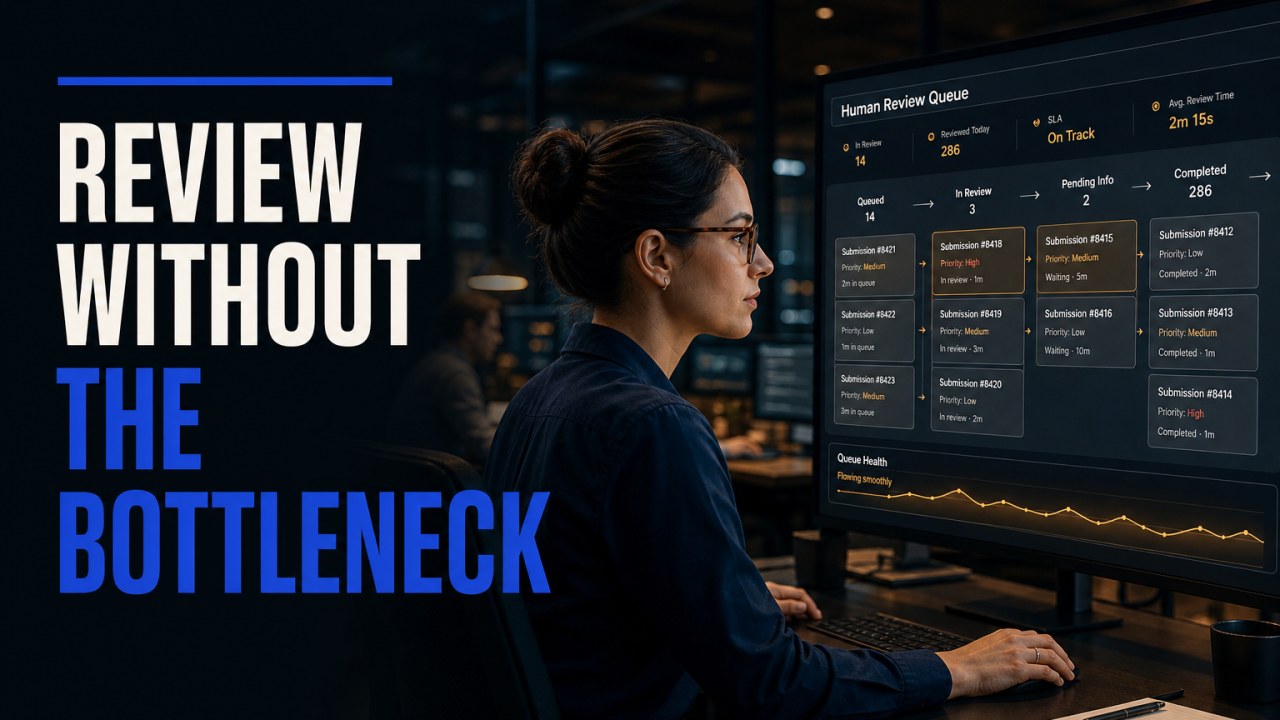
The AI scales. The humans don't. That's the sentence that ends more AI projects than model failure.
Here's the story. The AI goes into production and it works. Volume grows — that's the point. Every output that matters goes to a human reviewer, because that's the safe design. And the review queue grows with the volume, until the reviewers are the bottleneck, the queue is the latency, and the whole operation is slower than it was before the AI.
The review queue isn't a detail. It's the system's throughput limit, and it's the thing that decides whether AI at scale is a win or a treadmill. Designing it properly is the difference.
The queue design that scales
The naive review design is one queue, one reviewer, everything checked. It's simple and it collapses the moment volume grows. The design that scales has three properties.
Tiered review. Not every output needs the same scrutiny. A routine answer with high confidence doesn't need a human at all — or needs a spot check. A customer-facing answer needs a human. A compliance-adjacent answer needs a human plus a second look. Sort outputs into tiers by stakes and confidence, and give each tier a different review depth. Review hours are finite. Spending them where they matter is the whole design.
Sampling instead of checking. The highest-volume, lowest-stakes tier doesn't need 100% review. It needs a sample. Review every tenth output, or every output above a risk threshold. Sampling catches systemic problems — the model drifting and the prompt degrading — without the cost of checking everything. The sample isn't a compromise on safety. It's the allocation of attention to where the risk actually lives.
Batching over streaming. Humans are worse at reviewing one item at a time, as they arrive, than they are at reviewing a batch. The queue that delivers in batches — every fifteen minutes, every hour — lets reviewers get into a rhythm, and rhythm is where accuracy and speed both live. Streaming review looks responsive and is actually slower, because every item pays a context-switch tax.
The review queue is a throughput system, not a to-do list. Tiers, samples, and batches are the design that keeps review hours flat while volume grows.
The queue math that matters
The number that decides whether your queue scales is simple: review hours per thousand outputs. It's the unit cost of trust, and it should go down over time.
The queue that scales has a falling review-hours-per-thousand curve. The AI improves, the tiers get tuned, the sample rates get calibrated, and each thousand outputs needs fewer human hours. The queue that doesn't scale has a flat or rising curve — volume goes up, review hours go up, and the operation is running in place.
The way you get the falling curve is the loop: measure the review rate, find the tier where reviewers are checking things that never get changed, raise the confidence bar there or drop it to sampling. Find the tier where errors slip through, add scrutiny there. The queue gets cheaper and safer at the same time, because the tuning is driven by the data the reviewers themselves produce.
The escalation loop that keeps the queue honest
The queue has a second job that doesn't look like a queue at all: it's the feedback path that makes the AI better. Every review decision is data. The reviewer flagged this, changed that, approved this. That data is the eval signal, the retraining material, the drift detector.
The design that gets this right closes the loop. Review decisions feed back into the eval suite as new cases. Patterns in the flags feed back into prompt or model changes. The rising flag rate on one task type feeds back into the tiering — that task needs more scrutiny or a model upgrade. The queue stops being a cost center and becomes the sensor array for the whole system.
The review queue that's only a queue — check, approve, done — is a bottleneck with a salary. The review queue that feeds the loop is the thing that makes the AI measurably better every week.
The staffing truth
The honest part: the queue needs the right reviewer, and the right reviewer isn't whoever's free. It's the person who knows the domain well enough to catch the error the model makes confidently. A generic reviewer catches the obvious mistakes and misses the ones that matter — the plausible-sounding wrong answer that only a domain expert recognizes.
That's why the domain owner is part of the review design, not an afterthought. The reviewer who catches the expensive errors is the one who knows the work. Design the queue around their time — batch the reviews, tier the depth, sample the routine — because their hours are the scarcest resource in the system.
The AI will scale. The humans won't. The design that respects that — tiers, samples, batches, and a loop that makes the queue cheaper over time — is the design that lets you scale the AI anyway. Review hours are the constraint. Treat them like one, and the queue stops being the bottleneck and becomes the quality engine.
Think this argument fits your event? Tell me about the room — the calendar is selective.
Start a conversation