Every Engineering Leader Should Have an AI Architecture Advisor

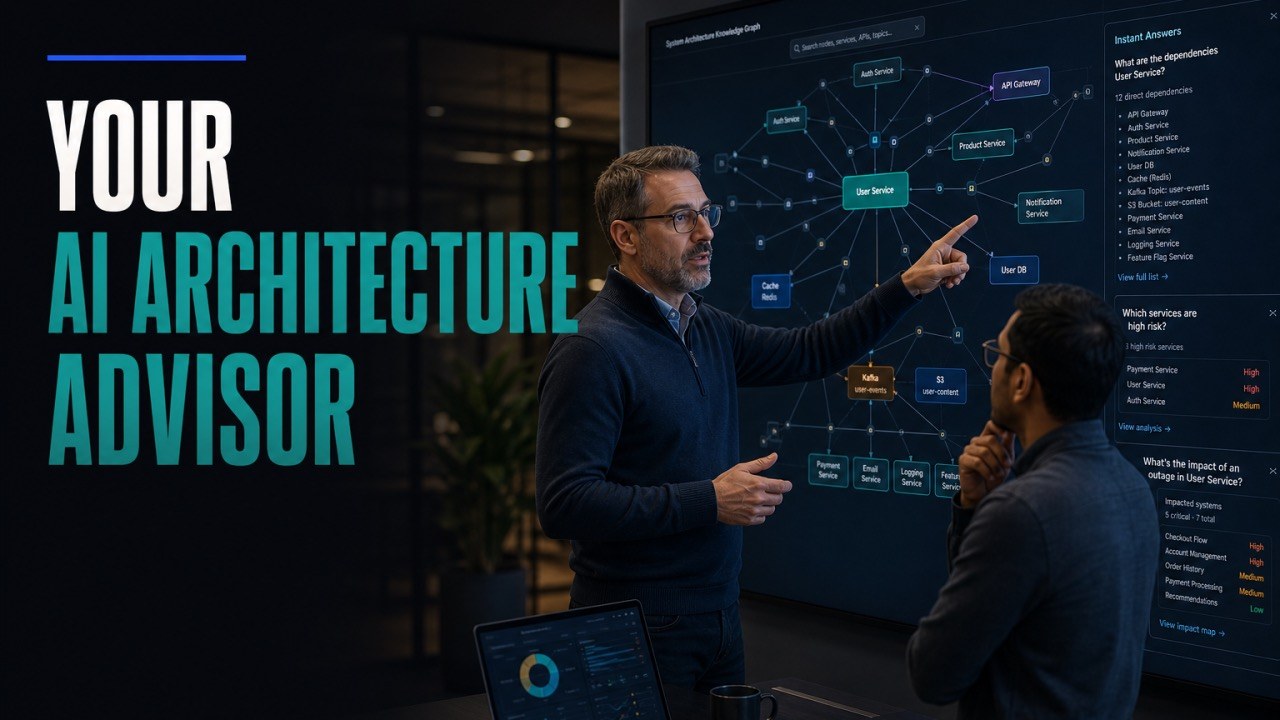
Most engineering leaders have someone they rely on for the hard questions. A senior architect. A staff engineer. Someone whose judgment you trust when the trade-offs are ambiguous. That person is invaluable. And they can't be everywhere at once.
This is where having an AI architecture advisor changes things. Not replacing the human architect — but giving every team access to architectural judgment that never sleeps.
What an AI Architecture Advisor Does
It's not a code generator. It's a continuous review system that watches for architectural drift — did this change violate established patterns? Security regressions — does this open a new attack surface? Ownership gaps — is there a service nobody has touched in months? Dependency risk — is a critical path depending on an unmaintained library? Decision consistency — does this conflict with a decision made six months ago?
Why This Matters
Modern systems exceed any one person's ability to track. A human architect can review major proposals. They cannot review every PR, every config change, and every dependency update. AI can — not with perfect judgment, but with consistent attention. And consistency matters more than perfection for catching drift before it becomes a crisis.
The Human Role Changes
The human architect's job shifts from "catch everything" to "train the system and handle exceptions." They define the rules, review the AI's findings, and make the calls on ambiguous cases. That's a better use of their expertise than reading every diff.
What I've Learned Building One
I've been building AI architecture advisors for the last year. Here's what I've learned. The tool itself is the easy part. The hard part is the knowledge foundation. If your architecture decisions aren't documented, if your incident history isn't captured, if your organizational standards aren't written down — the AI has nothing useful to work with.
The teams that get value from AI architecture advisors are the ones that already have good architecture practices. They document decisions. They track incidents. They maintain standards. The AI amplifies what they're already doing. It doesn't create good practices out of nothing.
This is a common pattern I see across AI adoption. The organizations that benefit most are the ones that were already well-organized. The AI makes them better. It doesn't fix underlying dysfunction.
The Risk of Over-Reliance
There's a real risk that teams start trusting the AI advisor too much. It becomes the new bottleneck — not in throughput, but in thinking. Teams stop reasoning about architecture and just accept whatever the AI suggests.
The best defense is to treat the AI advisor as a reviewer, not a decider. It flags inconsistencies, surfaces past decisions, and highlights risks. The humans still make the call. The AI informs. The team decides. That's the healthy balance.
Getting Started
Start with one standard. Pick the architecture rule your teams violate most often — maybe it's service boundary violations, dependency direction, or data flow patterns. Encode it as a review rule. Apply it to every relevant change.
See what happens when teams get immediate feedback instead of waiting for a review board. Usually, the violations drop sharply within weeks. Teams learn the standards faster. Architects spend less time enforcing rules and more time doing actual architecture.
You don't need a perfect system to start. You need one rule, one feedback loop, and the willingness to iterate. The rest will follow.
The goal isn't to automate architecture. It's to augment architectural attention — because attention is the scarcest resource in engineering leadership.
Think this argument fits your event? Tell me about the room — the calendar is selective.
Start a conversation