The Five Signals Every AI System Must Emit

Most AI systems in production are running blind, and the operators don't know it until something catches fire.
The classic software stack has telemetry everywhere. Metrics, logs, traces, dashboards, alerts. When the database slows down, someone sees it in the first minute. When the API errors spike, the on-call gets paged. The system is observable because the team built observability into it from the start.
AI systems get none of that. The model is treated like a magic box — you send it input, it sends back output, and if the output is wrong, nobody knows until a customer does. The model is the most unpredictable component in your stack, and it's the one you're watching least. That's backwards.
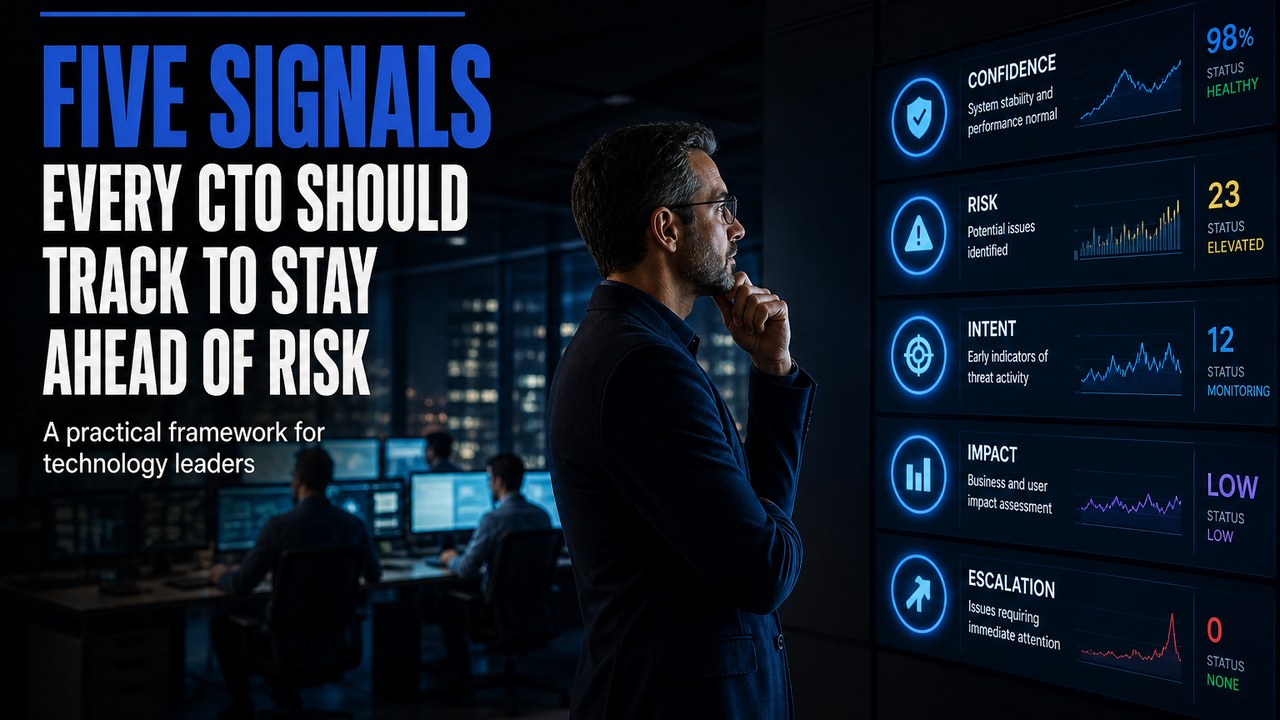
The fix is five signals. Every AI system in production should emit them, and they should land on one dashboard. If you have these five, you can operate AI like you operate everything else. If you don't, you're guessing.
The five signals
Signal one: confidence. The model's own estimate of how likely its answer is to be right. This is the raw material of trust — the number that tells you whether the output can be acted on or needs a human. Track it, distribution not just average, because the average hides the dangerous tails. The system that averages 0.9 confidence but occasionally drops to 0.4 on customer-facing requests is a system with a hole in it.
Signal two: latency. The time from request to response. AI latency is different from normal latency because it's so variable — a short prompt and a long prompt, a cold model and a warm one, and the difference can be ten times. Track the tail, not the mean. The p95 latency is the number your users feel.
Signal three: escalation rate. The percentage of outputs that get sent to a human. This is the health signal nobody tracks, and it's the most informative one. Escalation rate is the business telling you how much it trusts the AI. It goes up when the model degrades, when the data drifts, when the task gets harder. A rising escalation rate is the earliest warning of a system going sideways.
Signal four: override rate. The percentage of outputs a human actively changes before they go out. Escalation says "this needs a human." Override says "the human disagreed with the AI." The gap between the two is the model's actual error rate, and the trend is the model's actual quality. This is the signal that turns "the AI feels off" into a number.
Signal five: drift. The change in the distribution of inputs, outputs, and confidence over time. The world moves, and the model's performance moves with it. Drift is the signal that catches the slow decay — the data source that changed format, the customer mix that shifted, the question patterns that evolved. By the time accuracy visibly drops, drift has been running for weeks.
The five signals are confidence, latency, escalation, override, and drift. They're the vital signs of an AI system, and they're the difference between operating and guessing.
The one dashboard
The signals matter only if they land somewhere visible. One dashboard, five panels, no more. The operator should be able to look at it in thirty seconds and answer three questions: is the system healthy right now, is it getting better or worse, and what changed recently?
The dashboard is where the signals become a story. Confidence drops and escalation rises together, meaning the model is getting less sure and the business is noticing. Override spikes while escalation stays flat, meaning the humans are quietly fixing errors that never reach the review queue. Drift climbs on one input source, meaning something changed upstream and it's time to look.
The panels don't need to be fancy. A time series for each signal, a threshold line for each, and a color. Green, yellow, red. The dashboard is the translation layer between the model and the operator, and its whole job is to make the health of the AI as obvious as the health of the database.
What the signals tell you, and when
The signals are early-warning systems, and each one has its own lead time.
Drift is the earliest. It starts weeks before anything else moves, and it tells you the world is changing under the model. Escalation is next — the business starts noticing, and the rate ticks up. Override follows — the humans are doing more of the work. Confidence and latency are the laggards, the ones that move when the problem is already real.
The operator's job is to catch the early signals and act while the system is still healthy. Drift is climbing — investigate the data source now, not when accuracy collapses. Escalation is ticking up — review the task, the prompts, the model version, before the queue becomes the story. The signals don't predict the future. They give you the lead time to act before the incident.
The build cost
Five signals sounds like a project. It's a week. Confidence comes from the model's own output. Latency comes from the request path. Escalation and override come from the review tooling, which you should have anyway. Drift comes from logging the input distribution. Wire the five into a dashboard, put a threshold on each, and you're done.
The teams that skip this pay for it in incidents. The AI does something wrong, nobody knows how long it's been wrong, nobody knows how widespread, and the investigation starts from zero. Five signals wouldn't have prevented the mistake — no telemetry does. But they would have told you the day it started, the scope it reached, and the fix it needed.
The model is the most unpredictable component in your stack. Watch it like it is. Five signals, one dashboard, thirty seconds to read it. That's the whole observability layer, and it's the difference between operating your AI and hoping it operates itself.
Think this argument fits your event? Tell me about the room — the calendar is selective.
Start a conversation