From the Kitchen Table to the CNCF Stage: Why I'm So Proud of Chris Maher, and What It Tells Us About the Future of AI
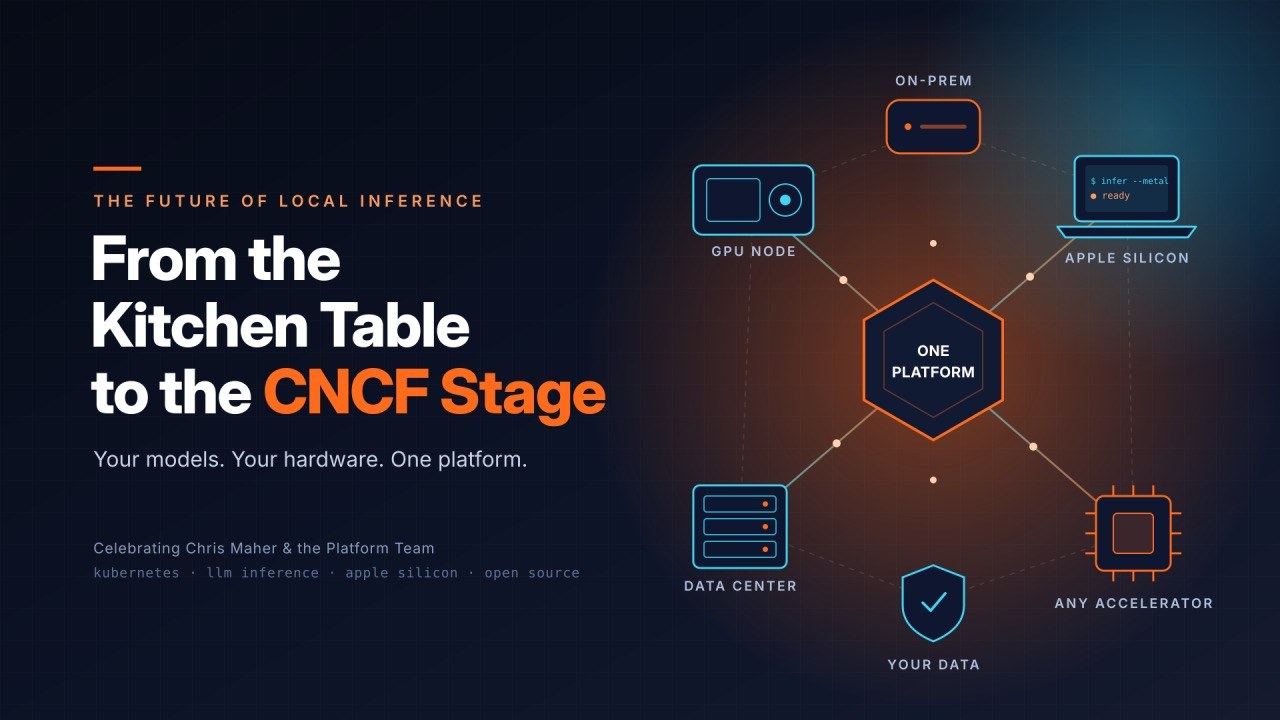
Some moments as a leader stop you for a second. Watching Christopher Maher present “Turning Apple Silicon into Production GPU Nodes” for the Cloud Native Computing Foundation was one of them.
Chris didn’t wait for permission or a budget line. He saw a problem and started building, at his kitchen table. The result is LLMKube, an open-source Kubernetes operator that runs large language models on whatever hardware you have, from one spec. NVIDIA GPUs, AMD, and yes, the Mac sitting on your desk.
The problem Chris solved
Here’s the hard part. Apple Silicon has a seriously capable GPU and unified memory, and you can’t reach that GPU from inside a container. For anyone running Kubernetes, that has meant a whole class of hardware sat outside the platform.
Chris didn’t fight that limit. He turned it around. LLMKube runs a small native agent on the Mac. The agent watches the cluster for inference workloads, launches the model server natively with full Metal GPU access, and registers the endpoint back into Kubernetes. To the rest of the platform, a Mac Studio is just another inference node. It’s managed the same way, observed the same way and governed the same way.
That’s not a hack. That’s platform thinking.
Why this matters beyond one clever operator
I’ve said for a while that the next chapter of enterprise AI won’t only be written in someone else’s data center. It will be written on infrastructure we own and control. Local inference is moving from a hobbyist curiosity to a strategic capability, for three reasons:
- Economics. Token costs add up fast at enterprise scale. When inference runs on hardware you own, cost becomes something you can measure, predict and optimize, instead of a surprise on an invoice. Chris has gone as far as measuring real dollars-per-million-tokens from live power telemetry on Apple Silicon. That’s the kind of rigor CFOs love.
- Sovereignty and security. Your data, your models, your hardware. For regulated, proprietary or simply sensitive workloads, keeping inference inside your walls is the cleanest answer to “where did our data go?”
- Heterogeneity is the new normal. No one will standardize on a single accelerator. The winning platforms will treat GPUs, Apple Silicon and whatever comes next as one pool of compute, scheduled with the same Kubernetes patterns our teams already know. Chris is building exactly that.
The frontier models in the cloud will keep getting better, and we’ll keep using them. But the future is hybrid: frontier intelligence where you need it, and fast, private, cost-controlled local inference everywhere else. The organizations that master both will move faster than everyone else.
What I’m most proud of
The technology is impressive, but that’s not what got me.
It’s that Chris built in the open from day one. He’s shipping releases at night and on weekends, writing honest benchmarks (including the ones that didn’t go well), and earning the respect of a global community. It’s that he represented our Platform Team on one of the biggest stages in cloud native computing. And it’s that he’s showing every engineer on our team that great ideas can come from anywhere and anyone.
My job as a leader is to clear the path, then get out of the way. Chris and our Platform Team are proof of what happens when you do.
What’s next
We’re building the future of how software and AI get made: platforms where humans and AI agents work side by side, on infrastructure that’s secure, observable and ours. Work like Chris’s is the foundation for that. It’s the plumbing that lets an engineer lead not just a team of people but a fleet of agents, running wherever the economics and the security model make the most sense.
To our Platform Team: this is just the beginning. Let’s keep building amazing things.
Christopher Maher, congratulations. Incredibly well deserved. 👏
Watch the talk: https://www.youtube.com/watch?v=8jFui8KHK80
#AI #LocalInference #Kubernetes #CloudNative #CNCF #OpenSource #PlatformEngineering #AppleSilicon #Leadership #AshleyFurniture
Think this argument fits your event? Tell me about the room — the calendar is selective.
Start a conversation