The Future of Manufacturing AI Lives at the Edge

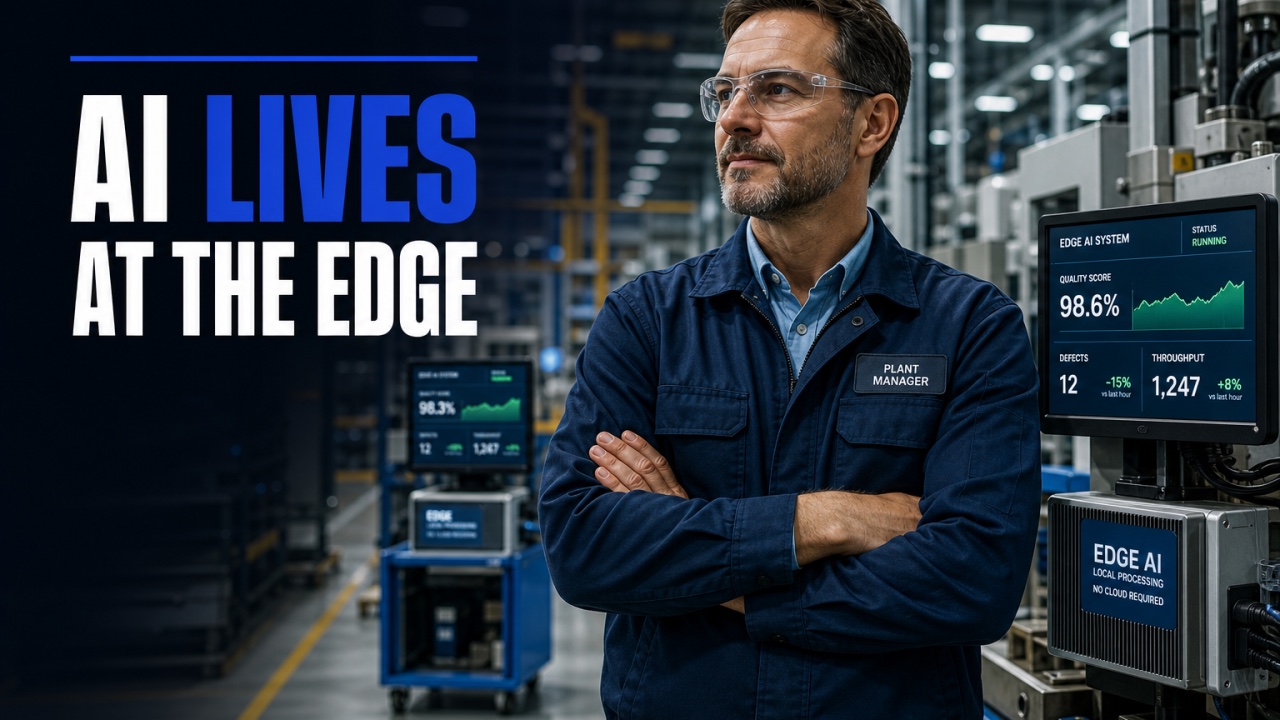
How practical, local intelligence is transforming factories—quietly and effectively
For years, AI in manufacturing was framed as a moonshot. Centralized models. Massive data lakes. Long feedback loops. Big promises that felt far away from the plant floor.
That era is ending.
The most impactful AI in manufacturing today isn't abstract, centralized, or theoretical. It's local. It's fast. And it lives at the edge.
What “AI at the Edge” Really Means
Edge AI doesn't mean “smaller AI.” It means closer intelligence. Models run:
• On machines
• Near sensors
• Inside production lines
• At the point where decisions actually matter
Instead of shipping raw data to the cloud and waiting for insight, edge AI processes information where it's generated—in milliseconds, not minutes. For manufacturing, that changes everything.
Why Manufacturing Is the Perfect Fit for Edge AI
Factories already operate in a world that edge AI understands well:
• Real-time constraints
• Physical processes
• Repetitive patterns
• Clear success and failure states
Manufacturing doesn't need AI that debates philosophy. It needs AI that:
• Detects anomalies
• Anticipates failures
• Optimizes continuously
• Responds instantly
Edge AI excels at exactly this kind of work.
Practical Wins Manufacturers Are Seeing Today
This isn't hypothetical. It's happening now.
1. Predictive Maintenance That Actually Predicts. Edge models monitor vibration, temperature, acoustics, and power signatures locally—spotting failure patterns before humans can.
No waiting. No bandwidth bottlenecks. No central system delay. Just early warnings where they matter most: at the machine.
2. Quality Inspection at Line Speed. Computer vision models at the edge inspect parts in real time, flagging defects without slowing production. This enables:
• Higher yield
• Less scrap
• Immediate correction instead of postmortems
Quality becomes continuous, not sampled.
3. Smarter Process Control. Edge AI adjusts parameters dynamically:
• Feed rates
• Pressures
• Temperatures
• Timing
Instead of static setpoints, processes adapt to real-world variation. That's not automation. That's optimization in motion.
Why Edge AI Is Easier to Implement Than You Think
One of the biggest myths about AI in manufacturing is that it requires a full digital transformation before value appears. Edge AI flips that model. You can start:
• One machine at a time
• One use case at a time
• One line at a time
No massive data migration. No “boil the ocean” architecture. Just targeted intelligence where ROI is clear.
Edge AI Respects the Plant Floor
Another reason edge AI works so well in manufacturing: it doesn't fight reality.
• Connectivity isn't perfect? Fine.
• Latency matters? Solved.
• Security concerns? Local processing reduces exposure.
• Operator trust matters? Edge AI augments, not replaces.
Edge systems work with operators, not over them. They provide insight, not edicts.
The Cloud Still Matters—Just Not Alone
This isn't an argument against the cloud. It's an argument for balance. In a modern manufacturing stack:
• The cloud handles aggregation, training, and enterprise insight
• The edge handles execution, detection, and control
Strategy in the cloud. Judgment at the edge. That division mirrors how good organizations already work.
The Real Opportunity: Compounding Gains
The power of edge AI isn't a single breakthrough. It's accumulation. Small improvements compound:
• Less downtime
• Higher yield
• Better consistency
• Faster learning loops
Over time, plants don't just become more automated. They become more intelligent.
A Positive Truth About AI in Manufacturing
AI doesn't need to replace people to be valuable. In manufacturing, it succeeds by doing something far better: it helps humans:
• See earlier
• React faster
• Decide with confidence
• Improve continuously
Edge AI is not disruptive in the chaotic sense. It's constructive. And that's why it's working.
Closing Thought
The future of manufacturing AI won't be defined by grand platforms or distant intelligence. It will be defined by thousands of small, local decisions made better—right where the work happens.
That future isn't coming. It's already on the factory floor.
Think this argument fits your event? Tell me about the room — the calendar is selective.
Start a conversation