Setting Confidence Thresholds With Data, Not Vibes

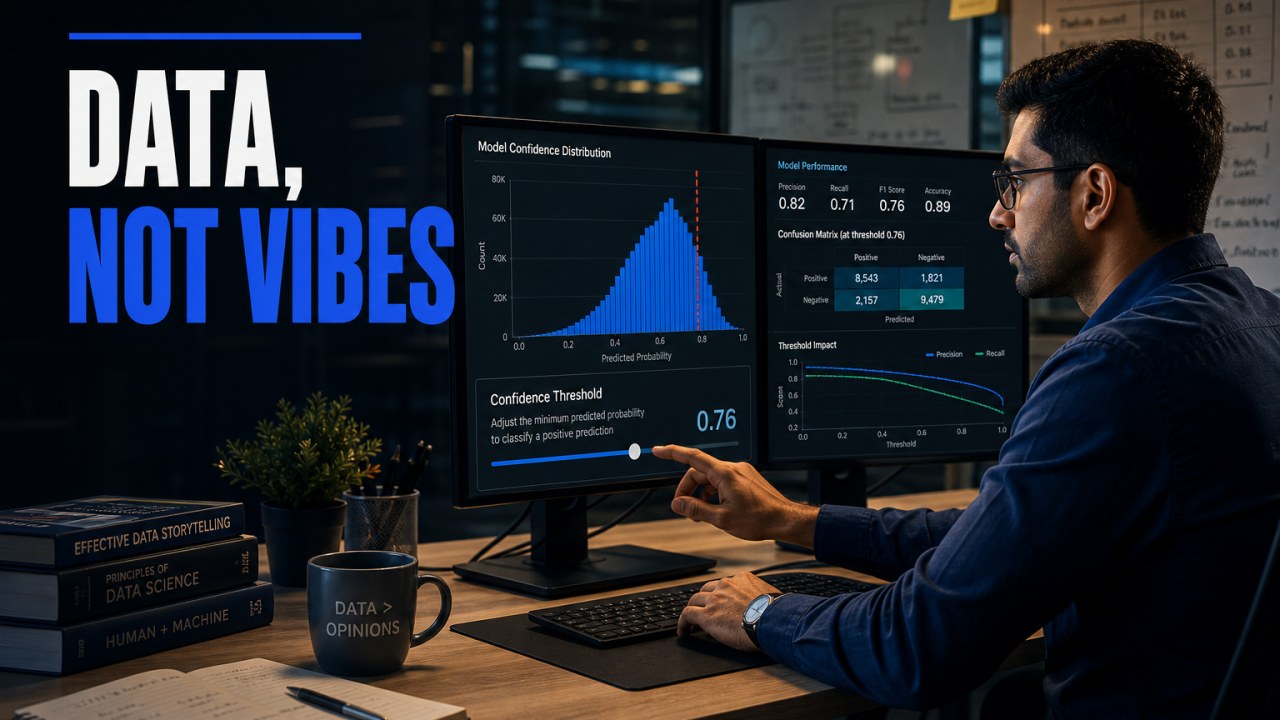
Somewhere in your AI system there's a confidence threshold, and I can tell you how it was set: somebody picked a number that felt right.
The threshold is the line that decides whether the AI acts alone or sends the output to a human. It's the most important setting in the whole system — it determines the error rate, the review load, the cost, and the trust. And it's almost always set by a guess. Someone says "0.8 feels safe" or "we'll escalate below 0.7" and the number becomes policy, defended by vibes, and never revisited.
The threshold is a decision about risk and cost, and decisions about risk and cost are supposed to be made with data. Here's the three-step procedure that replaces the guess.
Step one: baseline the error rate
You can't set a threshold until you know what the model's confidence actually means. Start by measuring.
Run the system with no threshold — or a deliberately low one — and send everything to review for a couple of weeks. For each output, record the confidence and the review verdict: right or wrong. Now you have the raw material: the actual error rate at each confidence level.
Plot it. You'll see the shape of the model's calibration. Maybe the model is well-calibrated: errors cluster at low confidence and accuracy climbs with confidence. Maybe it's overconfident: errors show up at 0.9 and the model's confidence is a liar. Maybe it's miscalibrated in patches: great on some task types, terrible on others at the same confidence. The plot is the truth the vibes were hiding, and it's the foundation for everything that follows.
The threshold isn't a number you pick. It's a number you derive — from the error rate, the cost of error, and the tolerance of the task. Pick it first and you're guessing.
Step two: price the error
The same confidence level means different things on different tasks. The threshold has to know what a wrong answer costs.
For each task tier, name the cost of a wrong output that gets through. The internal summary where wrong costs an hour of rework — that tier can run at low confidence, because the cost of escalation (a human reviewing everything) exceeds the cost of the occasional error. The customer-facing answer where wrong costs an account — that tier needs a high bar, because the cost of error dwarfs the cost of review.
The pricing step is where the threshold becomes a business decision instead of a technical one. Two tasks, the same model, the same confidence curve, and two different thresholds, because the cost of being wrong is different. The threshold is the mathematical expression of the question from the business: what errors can we afford, and what does preventing them cost?
Step three: tune to the tolerance
Now set the number. For each task tier, find the confidence where the cost of letting errors through equals the cost of reviewing everything above it.
The math is simple. The cost of the threshold is the errors that slip through — error rate at the threshold, times the volume below it, times the cost per error. The cost of raising the threshold is the extra review — the outputs between the old and new thresholds, times the review cost each. The right threshold is where the two curves cross. Set it there.
Then watch it. The threshold isn't a monument. The model changes, the data drifts, the cost of error changes, and the threshold has to move with them. The quarterly recalibration is the discipline: re-run the baseline, re-price the errors, re-derive the number. The threshold that was right in January is a guess by June if nobody looked.
The common failure modes
The procedure has three classic failure modes, and they're worth naming so you can catch them.
The overconfident model: the baseline shows errors at high confidence, and no threshold will fix it. The answer isn't a higher bar. It's calibration — or a different model, or a task redesign. The threshold can't save a model whose confidence is a lie.
The all-or-nothing trap: one threshold for the whole system, set to protect the highest-stakes task, which means everything else pays the high review cost forever. The fix is per-tier thresholds, and the tiers come from the pricing step.
The frozen threshold: set once, defended forever, never re-derived. The fix is the calendar — the quarterly recalibration, scheduled, not remembered.
The question that replaces the guess
Next time someone proposes a confidence threshold, ask one question: what does the error curve look like, and what does an error cost?
If the answer is a plot and a price, you have a real threshold. If the answer is "0.8 feels right," you have a guess with a number attached, and the system will pay for it in errors or review costs — you just don't know which yet.
Baseline the error rate. Price the error per tier. Tune the threshold to the crossing. Recalibrate quarterly. That's the whole procedure, and it's the difference between a threshold that protects the system and a number that felt safe on a Tuesday. The model's confidence is a signal. Treat it like one — measure it, price it, and set the line where the data says.
Think this argument fits your event? Tell me about the room — the calendar is selective.
Start a conversation