The Standing AI Triage Meeting

Somewhere in your company there's a list of AI requests that never gets reviewed. It's growing. Nobody owns it. And every week it gets longer.
I see it everywhere. Teams start experimenting with AI, and the requests pile up — can we automate this report, can we summarize these calls, can we build a bot for that. Each one goes to a different person. Each one waits for a decision that never comes. And the pile becomes the graveyard where AI adoption goes to die.
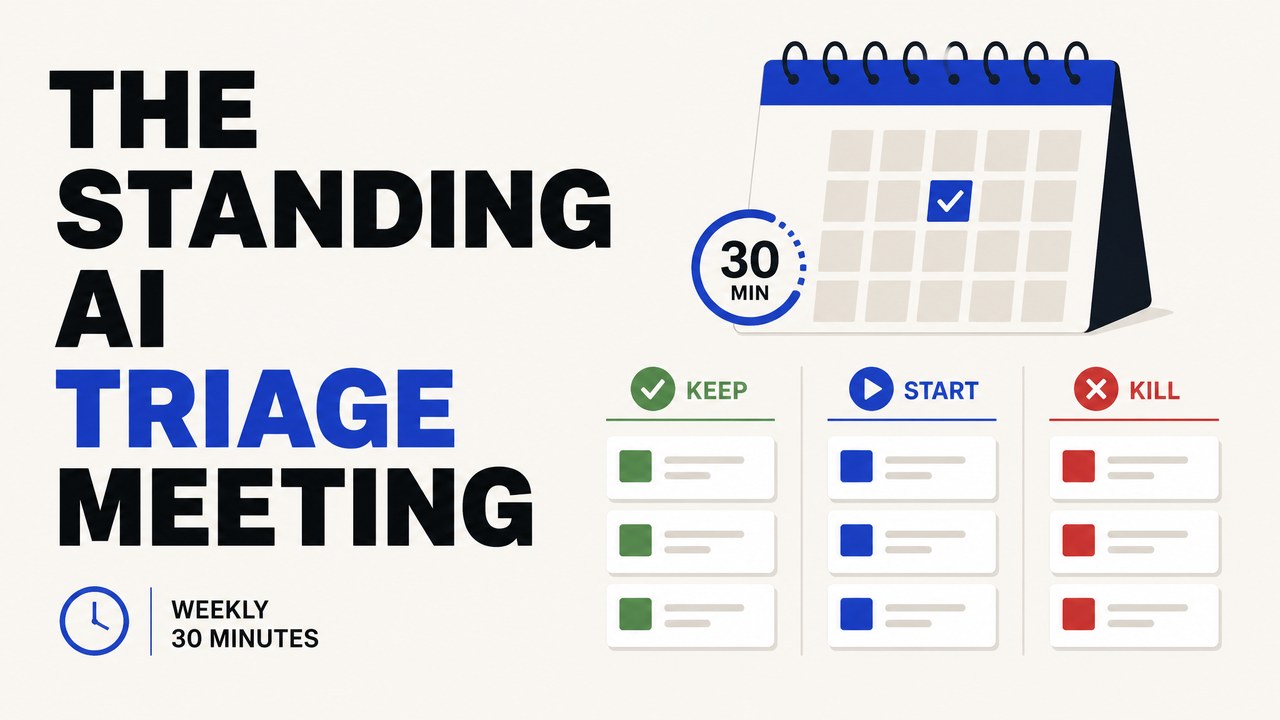
The fix is embarrassingly simple: a standing meeting. Thirty minutes, weekly, with one agenda and one decision each time.
Why requests stall without it
Requests don't stall because people are lazy. They stall because there's no mechanism. The person who receives an AI request has no standing to approve it, no budget line to fund it, and no clear process for what "yes" even means. So they do the natural thing: nothing. And nothing is what kills the initiative.
The request itself is the bottleneck. Every experiment that doesn't get a decision is a signal the organization is collecting but not processing. A standing meeting is the processing pipeline.
The triage meeting exists for one reason: every AI request gets a decision in thirty minutes or it gets one on the spot.
The agenda: three questions, one decision
The meeting is thirty minutes, once a week, and it runs the same way every time. Walk the list. For each request, three questions.
Does it solve a real problem? Not a cool problem — a real one. Does this request map to a cost, a cycle time, or a customer pain that actually exists? Most requests die here, and that's fine. Dying fast is the point. A request that dies in thirty seconds of honest assessment is a request that won't eat a team's quarter.
Can we do it with what we have? This is where scope gets real. The request that sounded huge — "automate our whole reporting process" — becomes a first step: "automate the Monday volume report." Almost every request has a v1 that's small enough to ship in two weeks with existing tools. The question forces that v1 into view.
Who owns it? This is the decision the whole meeting exists for. A request without an owner is a wish. A request with an owner is a project. The owner doesn't have to be an engineer. The owner is whoever feels the pain, because they're the one who'll know if the fix actually fixed it.
Three questions, one answer per request: kill it, start it, or park it with a date.
Who's in the room
The meeting works only if the people with standing are in it. You need three seats. Someone who can say no to scope — a manager or a lead. Someone who can say yes to effort — the person who'll do the work or get it done. And someone who can say yes to budget, even a small yes. If the meeting can't approve a two-week experiment and a hundred dollars, it's not a decision meeting. It's a discussion group, and you already have enough of those.
Keep it tight. Thirty minutes, hard stop. The meeting should be slightly uncomfortable in its efficiency. Decisions happen here, not conversation.
What changes after three months
Give it ninety days and watch what happens to the pile.
Requests stop dying silently — they get killed out loud, fast, with a reason. That's a real improvement, because a team told "no, because it doesn't solve a real problem" moves on. A team left in silence stops proposing.
The small wins start shipping. A two-week v1 here, a two-week v1 there. None of them are impressive alone. Together they're the difference between an organization that talks about AI and one that's using it.
And the pattern emerges. After a few months you'll see the requests cluster — the same task keeps coming up from different teams. That's your roadmap. That cluster is where you should build something properly, because it's demand you've now measured instead of guessed.
The part nobody writes in the agenda
The meeting has a second job that never appears in the agenda: it tells the organization that AI requests are taken seriously. When a team sees that their idea got a real decision in a real meeting with a real owner, they bring the next idea. When they see requests vanish into silence, they stop.
Adoption is a loop, and the loop needs a heartbeat. A standing meeting is the heartbeat. Thirty minutes, three questions, one decision, every week, no exceptions.
The pile doesn't have to be a graveyard. It just needs a referee. Start the meeting. Kill fast, start small, assign owners, and let the pattern tell you where to build next. That's the whole system.
Think this argument fits your event? Tell me about the room — the calendar is selective.
Start a conversation