Train Operators, Not Users: The 90-Day AI Fluency Plan

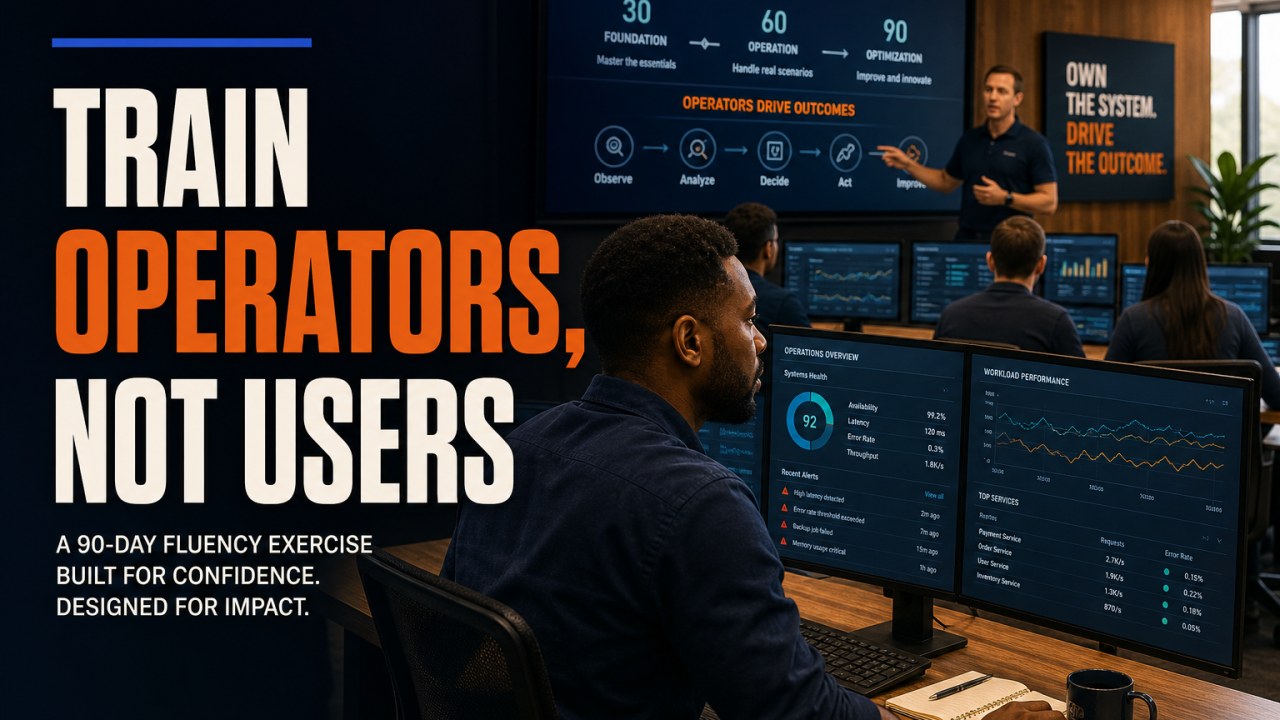
Most AI training is a lecture about a chatbot. That's not training. That's a demo with a sign-in sheet.
Here's the pattern I keep seeing: the company buys a license, schedules a two-hour session, shows everyone how to ask a question, and calls it adoption. Three months later, usage numbers are flat, the champions have burned out, and leadership wonders why the investment didn't stick.
The reason it didn't stick is the framing. You trained people to be users of a tool. The tool was the point. But the tool isn't the point. The work is the point. And the people who make AI work are the ones who know how to operate it inside their actual job — not the ones who can write a clever prompt in a training room.
Users vs. operators
A user knows how to ask. An operator knows when to trust, when to check, and when to override.
That's the difference that decides whether AI lands in your business. The user types a question, gets an answer, and moves on. The operator knows the answer could be wrong, knows which parts of it matter, knows what to verify, and knows who to escalate to when the stakes are high. The user is a passenger. The operator is the driver.
You can't teach operator judgment in a two-hour session. You can't teach it in a classroom at all. You teach it in the work, at the point where the decision actually happens.
The goal of AI training isn't fluency with the tool. It's fluency with the judgment the tool requires.
The 90-day plan: role-based, not generic
The universal training session is the first mistake. A warehouse lead, a buyer, and a finance analyst do not need to know the same things. The warehouse lead needs to know when to trust a load plan the AI generated. The buyer needs to know what to verify before a vendor price lands in the system. The finance analyst needs to know how to check the reasoning behind a variance explanation.
So the plan is three phases, role by role.
Phase one, days one to thirty: work through the job, not through the tool. Sit with each role and find the three tasks where AI genuinely helps — not the aspirational ones, the real ones. Draft the two or three prompts that actually work for that specific task. Give people a starting point they can use on day one. Nobody adopts a tool they have to figure out from scratch in the middle of a busy day.
Phase two, days thirty to sixty: introduce the judgment layer. This is where operators are made. For each role, walk through the failure modes. What does a wrong answer look like in this task? How do you check it? What's the cost of being wrong, and what do you do when the cost is high? This is the phase where people learn to distrust appropriately — not to distrust everything, but to know which answers deserve a second look.
Phase three, days sixty to ninety: move from following to teaching. Have each operator teach the next person. Teaching is the test. If you can explain to a coworker when to trust and when to check, you actually understand it. This phase also solves the scaling problem — you can't personally train every operator, but your operators can.
The metrics that matter
The 90-day plan needs a scoreboard, and it's not "number of prompts used." That's a vanity metric. The scoreboard is task-level: is the cycle time down on the tasks where AI should help? Is the error rate holding? Are people escalating appropriately instead of either trusting everything or trusting nothing?
The real signal is the questions people ask. In month one, they ask how to use the tool. In month two, they ask what to verify. In month three, they ask whether the AI's answer contradicts what they know to be true. That progression — from how to use, to what to check, to when to challenge — is the adoption curve. It's also the signal that operators are being made, not users.
What the operator gets out of it
The operator framing isn't just better for the company. It's better for the person. Nobody wants to be a passenger in their own job. The two-hour training session tells people the company thinks AI is a trick they need to learn. The 90-day plan tells them the company thinks they're professionals whose judgment now has a tool behind it.
That's the difference between a workforce that tolerates AI and a workforce that operates it. One gets a demo. The other gets a job that got better.
Three phases, role by role, ending with people teaching each other. Ninety days of judgment, not one afternoon of prompts. That's how you build operators. The tool was never the hard part.
Think this argument fits your event? Tell me about the room — the calendar is selective.
Start a conversation