What to Do When the AI Gives a Wrong Answer in Front of a Customer

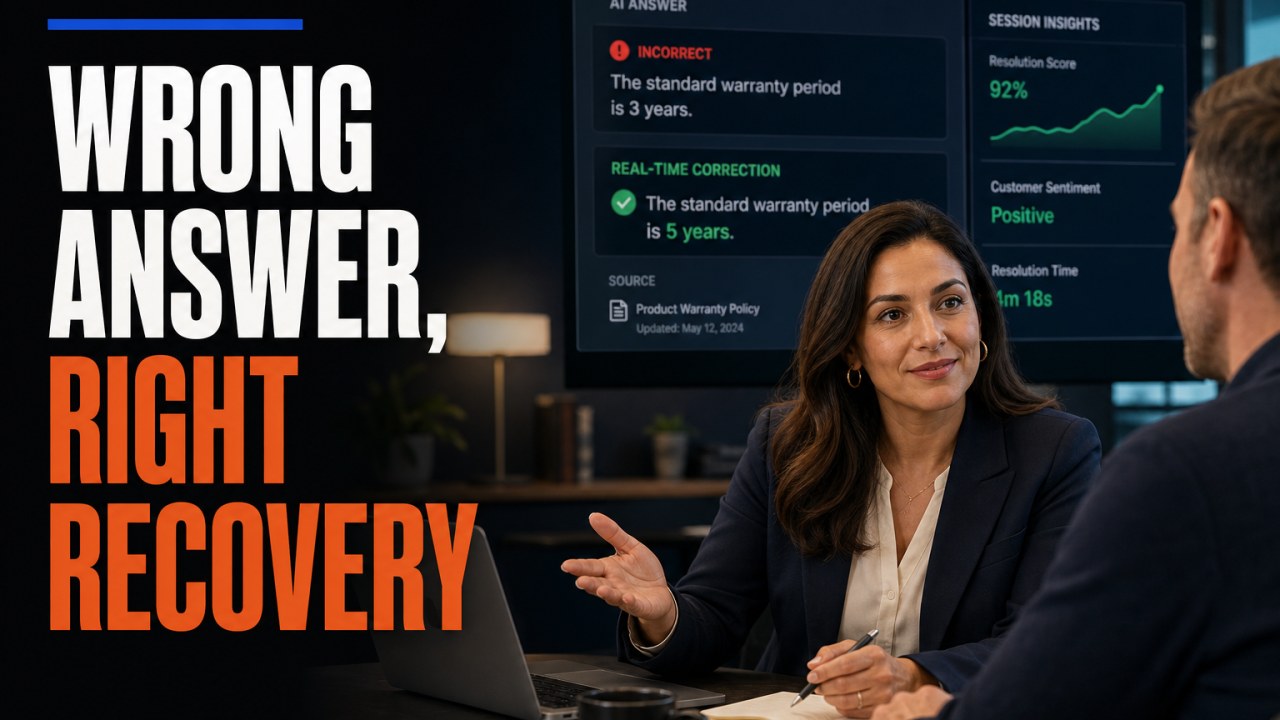
It's going to happen. The AI is going to give a wrong answer in front of a customer, and a human is going to have to fix it live.
Not might. Will. The question was never whether the AI makes mistakes. It's what the person on the other side of the counter does in the thirty seconds after it happens. That thirty seconds decides whether you lose the account or keep it.
Most organizations have no answer for that moment. The AI tool was rolled out, the operator was told it would help them, and nobody told them what to do when it lies. So they improvise. And improvising in front of a customer is how small errors become lost accounts.
The moment, second by second
Let's be concrete about what the moment looks like. A customer asks about pricing, delivery, or a policy. The AI answers confidently and wrong. The customer catches it, or the operator knows the real answer, or the numbers just don't look right.
Second zero: the operator acknowledges. Not "the system is wrong" and not "let me check the system." The customer doesn't care whose fault it is. The line is simple: "That's not right, and I'm glad you caught it. Let me get you the correct answer." Two sentences. It owns the error, thanks the customer, and promises a fix.
The rule is brutal and simple: the AI can be wrong, but the human can never be. Once the customer knows the answer is wrong, the human owns the fix, the apology, and the outcome.
Second ten: the operator gets the real answer. They check the source. They ask the lead. They pull the actual price sheet. This is the part that has to be fast, and it's the part most organizations never prepare. If the operator has to dig for ten minutes, the damage is done. The fix has to be within reach.
Second twenty: the operator delivers the correction, confirms it in writing if it matters, and closes the loop. "Here's the correct price, I've confirmed it against the current sheet, and I've noted the system error so it gets fixed." The last clause matters. It tells the customer the problem isn't just being patched around — it's being reported.
The two sentences that save the account
Every frontline operator needs the two sentences drilled in before they ever touch the AI tool. "That's not right, and I'm glad you caught it. Let me get you the correct answer." That's it. No blame, no confusion, no defensiveness.
Why does this specific phrasing work? Because it does three things at once. It validates the customer: "I'm glad you caught it" treats them as a partner, not an adversary. It de-personalizes the error, because the AI was wrong, not the operator and not the company's competence. And it pivots to action, since "let me get you the correct answer" is a promise of resolution, not an excuse.
The alternative phrasings are all landmines. "The system must be glitching" blames the tool and invites the customer to distrust everything else the company does. "Let me check" without the acknowledgment leaves the customer wondering if they're being gaslit. "I'm sorry" alone is an apology with no resolution attached. The two sentences handle all of it.
Log it, don't bury it
Here's the part most organizations miss. The wrong answer in front of a customer is data. It's a bug report from the field with a customer attached. If the operator fixes it and moves on, the error will happen again tomorrow, to another customer, in front of another operator.
So the close of the loop is a log entry. What was asked, what the AI said, what the correct answer was, and what the operator did. That entry is how the system gets better. It feeds the eval set, the retraining data, the list of known failure modes. One wrong answer logged is a lesson. Ten wrong answers logged is a pattern. A hundred is a fix with a business case.
The log also protects the operator. When the error happens, the record shows they caught it, fixed it, and reported it. That's the difference between an operator who looks like the problem and an operator who looks like the solution.
What this costs to prepare
Nothing. That's the part that should embarrass every organization that hasn't done it.
The training is fifteen minutes. Here's the two sentences, here's the log form, here's who to escalate to if the correction needs approval. The refresh is quarterly. The whole program costs less than the first account it saves.
The AI will be wrong. That's a fact of the technology. Whether the customer still trusts you after it happens is a decision you make before it ever does. Two sentences, a fast fix, and a log entry. That's the whole playbook, and it should be in place the day the AI goes live, not the day after the first incident.
The AI gets to be wrong. The human never does. Prepare for the moment and the moment becomes a story about how well you handled it, not the one where you lost the account.
Think this argument fits your event? Tell me about the room — the calendar is selective.
Start a conversation