Why Every Architecture Review Should Start With AI

Most architecture reviews follow a predictable pattern. Someone presents a proposal. People ask questions based on their own experience. Opinions are debated. The strongest voice or highest title wins.
This process worked when systems were simple enough that any experienced engineer could reason about them. It doesn't work when a proposal might affect sixteen services, three data pipelines, two external APIs, and a compliance boundary nobody remembered existed.
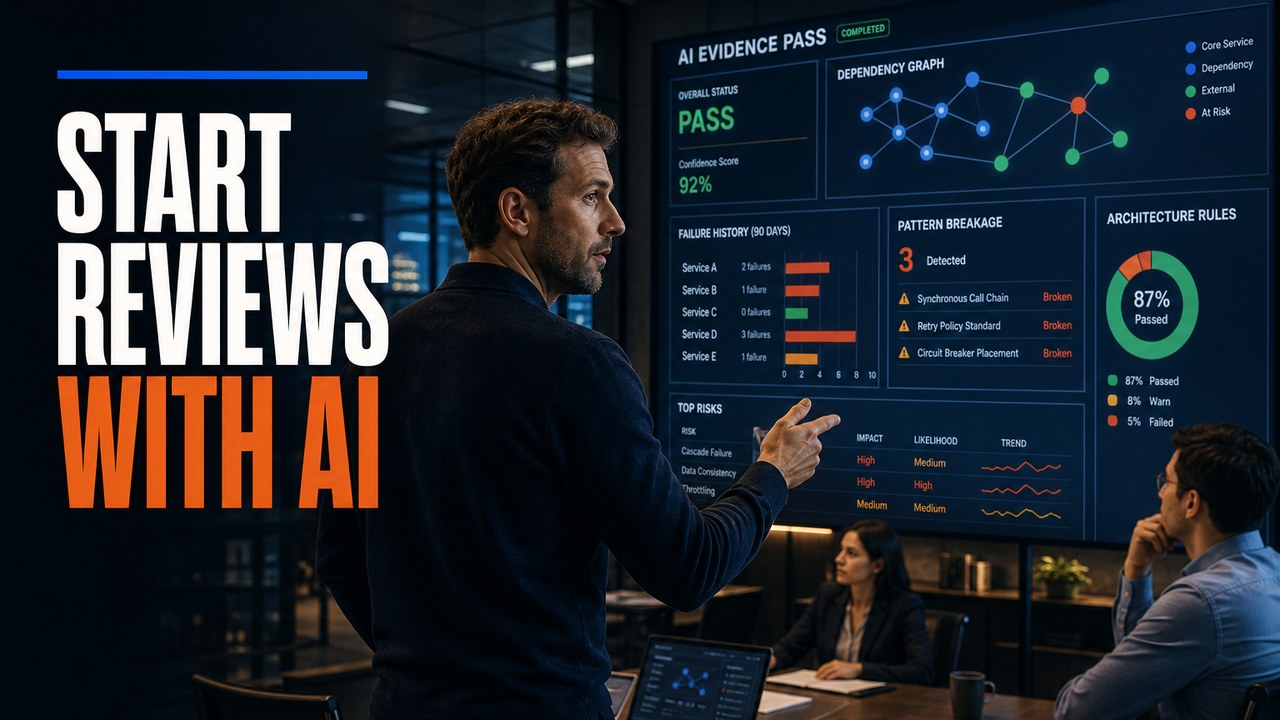
AI changes what an architecture review can be. Instead of relying on whoever happens to be in the room and what they remember, the review starts with facts.
What Those Facts Look Like
Before anyone offers an opinion, the AI surfaces the objective constraints. Which services does this change touch? What are their current failure rates? Are there past architecture decisions that conflict with this approach? What dependencies would this introduce, and what are those dependencies' reliability records?
I watched a team spend forty-five minutes debating whether to use Kafka or a simpler message queue. The heated discussion was about throughput, latency, and operational overhead. Someone finally asked the AI to check. It came back with the actual message volumes, the team's experience operating each system, and three past incidents related to the two technologies. The debate ended in under a minute. The answer was obvious once the facts were on the table.
These facts don't make the decision for you. They give you a foundation to make a better one.
Why the Opening Question Matters
The first question in a review meeting sets the frame. If it's "why do you want to use this technology?" the review becomes a debate about technology preferences. If it's "what are the known constraints and past decisions that apply here?" the review becomes a search for the best solution within reality.
AI enables the second frame. Because it's ingested the architecture decision records, incident history, dependency maps, and organizational standards, it can answer the factual questions immediately. The humans get to spend their time on what only humans can do — evaluating trade-offs that involve judgment, uncertainty, or competing priorities.
The Hardest Adjustment
The hardest part for experienced architects is admitting that intuition, while valuable, is not a sufficient basis for architecture decisions at modern scale. Your gut feeling that a proposal is risky might be right. But the reasons matter more than the feeling.
AI provides the evidence that supports or challenges your intuition. That makes the final decision defensible in a way that gut feeling never is. When someone asks six months later why a particular path was chosen, you don't have to say "it felt right." You can point to the data that informed the decision.
Start Every Review This Way
Build the habit. Before the first opinion is offered, before the first debate starts, ask the AI what it knows about the proposal. Not to replace human judgment — to give that judgment a factual foundation.
The answers won't make the decisions for you. They will make your decisions vastly better. And your teams will leave the room confident they didn't miss something obvious.
What Happens When You Skip the Facts
I once watched a team spend forty-five minutes debating whether to use Kafka or a simpler message queue. The discussion was animated. People had strong opinions based on past experiences with both technologies. Some argued for Kafka because it's the industry standard. Others argued for simplicity because the team had limited operations experience.
Someone finally asked the AI to check. It came back with actual message volumes, the team's experience operating each system, and three past incidents related to both technologies. The debate ended in under a minute. The answer was obvious once the facts were on the table.
That forty-five minutes was wasted not because the team was wrong to debate — but because they were debating without facts. The AI could have provided those facts at the start. The team just hadn't built the habit of asking.
The Real Resistance
The pushback I hear most often is "but the AI might miss something." That's true. It might. But so might any single person in the room. The difference is that the AI surfaces what it knows transparently, and the humans can challenge it. That's better than relying on whoever happens to have the strongest memory of a related incident from two years ago.
The question isn't whether the AI will be wrong sometimes. The question is whether starting from facts produces better outcomes than starting from opinions.
In my experience, facts win.
Making It a Habit
The teams that do this well have a simple rule: before anyone offers an opinion in an architecture review, the AI provides its findings. Not a replacement for judgment. Just the foundation for it.
That one rule shortens meetings, improves decisions, and builds confidence that nothing obvious was missed. Try it once. You'll see the difference immediately.
Think this argument fits your event? Tell me about the room — the calendar is selective.
Start a conversation