Your Data Is the Moat — and the Leak

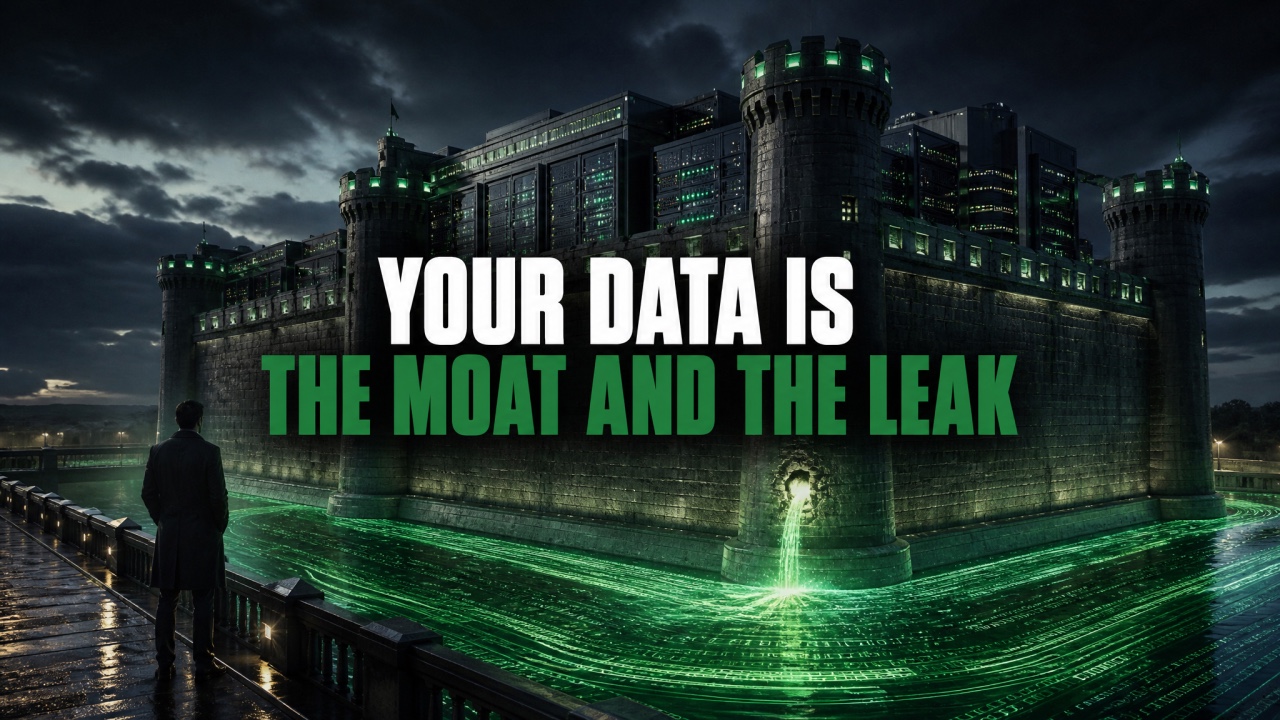
The pitch says your data is the moat. The fine print says the vendor's lawyers wrote the part about what happens to it.
Every AI vendor will tell you your data is what makes the system work. Your data is the training ground, the context, the differentiation. Your data is why this AI will be better than every other AI. The moat. The asset. The thing you must protect at all costs.
And then the contract arrives, and the same vendors want the right to process that data in ways you haven't read closely. The moat has a leak in it, and the leak is in the part of the deal you signed without a data-readiness review.
The audit before the vendor
Before you commit to any AI vendor, run the data audit. Not on the vendor — on yourself. You can't negotiate the terms of an asset you haven't inventoried.
The audit has four parts.
Quality. Do you know what your data actually is? Most organizations have data scattered across systems, in formats nobody documented, with quality nobody measured. The AI will perform exactly as well as the data you feed it, and if the data is messy, the disappointment is coming either way — either the vendor blames your data for bad results, or you pay them to clean it. Inventory the data, sample it, and be honest about what's there. The audit's first output is the truth about your data, which is the thing the demo never shows you.
Access. Who can touch what, and through what path? Your data has an access model — or doesn't. If any engineer can pull any dataset, the vendor's system inherits that. The audit maps the permissions before the data moves anywhere.
Permissions. Do you have the right to use this data for this purpose? This is the one that gets ignored until it hurts. Customer data, employee data, third-party data — the right to process it for AI may not exist in your contracts with the people the data belongs to. The vendor's system will happily process it. The lawsuit afterwards will not care that the vendor was happy.
Exit copies. Can you leave? If the vendor disappears, changes terms, or gets acquired, can you get your data back in a usable form? Not a dump. Usable. This is the audit item that looks paranoid and becomes the most important one the day it's needed.
The moat only protects you if the data stays yours. Quality, access, permissions, and exit copies are the four locks on the gate.
What the vendor actually asks for
Once you know what you have, you can read the vendor's data terms with open eyes. The asks come in predictable shapes.
The training ask: the vendor wants to use your data to improve their model. Sometimes it's explicit, sometimes it's buried in "service improvement." The question isn't whether they'll say yes to removing it — it's whether the removal is a real option or a marketing one. Get the no-training clause in writing, and understand that "we don't train on your data" can mean different things for different parts of the platform.
The retention ask: the vendor wants to keep your data after the contract ends, for "operational" reasons. The question is how long, in what form, and who can access it. Retention is where the moat leaks quietly — the data stays in their systems, getting older and less protected.
The liability ask: the vendor wants the data-processing relationship structured so that when something goes wrong with your data, the responsibility flows back to you. This is the clause where the vendor positions itself as the neutral processor and you as the responsible party, even though you're paying them to handle it.
The negotiation that protects the moat
The good news: every one of these asks is negotiable, and the negotiation is easier than you think, because the vendors have standard answers and standard counters.
No-training is becoming table stakes for enterprise deals. Push for it explicitly and get it in the contract, not the marketing materials. Retention gets a defined window and a defined form — specify what "deletion" means and require confirmation. Liability gets rebalanced by requiring the vendor to stand behind their own processing errors, which is the same allocation you'd expect in any other software deal.
The frame that makes the negotiation work: your data is the thing that makes their product useful to you. That's negotiating power, and you should use it. The vendor who can't agree to protect the asset that makes their product work is telling you how they'll treat you later.
The maintenance after the deal
The audit isn't a one-time event. Data changes, permissions change, vendors change. The quarterly check is twenty minutes: has the data changed in ways that matter? Have the permissions held? Is the exit copy current? The organizations that lose their moat rarely lose it in one dramatic event. They lose it in a hundred small ones — the dataset that moved to a new system nobody documented, the contract renewal nobody read, the vendor acquisition that changed the terms overnight.
The moat story is true. Your data is the thing that makes AI worth having, and the organization that treats its data like an asset — audited, protected, and portable — is the one that gets the real benefit. The leak story is also true. The data that isn't inventoried, protected, and documented is the data that leaks.
Run the audit before the deal. Read the terms with open eyes. Negotiate the four asks. And check the locks quarterly. Your data is the moat. Keep it yours.
Think this argument fits your event? Tell me about the room — the calendar is selective.
Start a conversation